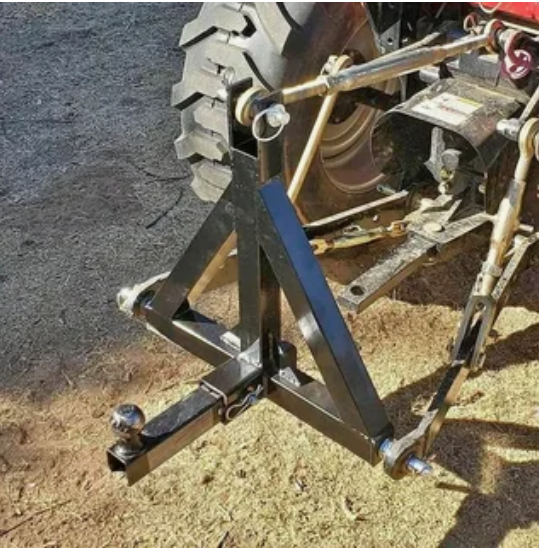
A tractor becomes significantly more useful when it can work with the right implements and attachments. One of the most important systems for connecting rear-mounted equipment is the 3 point tractor hitch. This hitch design allows compatible implements to be connected, raised, lowered, and positioned according to the needs of the job.
For owners of John Deere equipment, selecting the correct John Deere attachment is equally important. Compatibility depends on the tractor model, hitch category, implement requirements, and intended application. John Deere offers three-point hitch systems and attachments for a wide range of tractors, including compact utility models and larger equipment.
What Is a 3 Point Tractor Hitch?
A 3 point tractor hitch is a three-link connection system used to attach implements to a tractor. The system generally consists of two lower arms and an upper link. Together, these connection points provide stability and allow the tractor to lift and position compatible equipment.
Three-point hitches are commonly used with implements such as rotary cutters, box blades, tillers, rear blades, and other agricultural or landscaping equipment. The hitch can make changing implements easier while providing control over the working height of attached equipment.
The exact hitch category matters when choosing an implement. Category 1, Category 2, and other hitch classifications have different dimensions and capacities, so owners should always verify the specifications for their particular tractor before purchasing equipment.
Why a Three-Point Hitch Is Useful
One of the biggest advantages of a three-point hitch is versatility. Instead of using a tractor for only one purpose, operators can connect different implements for different tasks.
For example, an appropriately equipped tractor can be used for mowing, grading, tilling, landscaping, material handling, and other agricultural work. John Deere describes its three-point hitch kits as providing enhanced equipment versatility and allowing compatible rear-mounted equipment to be used for tasks such as tilling and mowing.
The hydraulic system can also allow the operator to raise or lower an attached implement from the tractor seat. This makes it easier to adjust equipment during operation and transport.
Choosing a John Deere Attachment
When selecting a John Deere attachment, the first step is identifying the exact tractor model. Attachments are not universally compatible with every John Deere tractor.
For example, John Deere lists a Category 1 three-point hitch kit, BUC10169, as compatible with a range of models including the X475, X700, X710, X720, X724, X728, X729, X730, X734, X738, X739, X740, X744, X748, X749, X750, X754, and X758, among others.
This illustrates why checking model compatibility is important before purchasing an attachment or hitch component.
Understanding Hitch Categories
A tractor’s hitch category determines which implements can be connected. Category 1 is commonly found on smaller and compact tractors, while larger tractors may use higher categories.
However, tractor size alone should not be used to determine compatibility. Always check the manufacturer’s specifications or operator’s manual for the exact model.
John Deere offers different hitch components depending on the tractor. For instance, its BLV10088 lift-arm and torsion-tube attachment is a Category 1 component and is listed for models including the 3033R, 3038R, 3039R, 3045R, 3046R, 4044M, 4044R, 4049M, 4049R, 4052M, 4052R, 4066M, and 4066R.
Matching the Attachment to the Job
Once the tractor model and hitch category are known, consider the actual task. Different implements are designed for different applications.
A rotary cutter may be suitable for maintaining grass and vegetation, while a box blade can be useful for grading and leveling. A tiller may be selected for soil preparation, while a rear blade can assist with certain landscaping or surface-maintenance tasks.
The best John Deere attachment is therefore not simply the largest or most powerful option. It should match the tractor’s capabilities and the work being performed.
Hydraulic Control and Adjustability
Many three-point hitch systems use the tractor’s hydraulic controls to raise and lower attached implements. This provides the operator with greater control over equipment positioning.
John Deere’s BUC10169 Category 1 three-point hitch kit, for example, is described as using the tractor’s hydraulic control lever for raising and lowering equipment. The kit also includes a draft-arm height adjuster that can help level or tilt mounted equipment.
These features can be especially useful when working over uneven terrain or when an implement needs to be adjusted for different operating conditions.
Checking Attachment Compatibility
Before purchasing a John Deere attachment, review several specifications rather than relying only on the tractor’s brand name.
Check:
- Exact tractor model
- Hitch category
- Lift capacity
- Attachment weight
- Hitch-pin dimensions
- PTO requirements, if applicable
- Hydraulic requirements
- Manufacturer compatibility information
These details can prevent compatibility problems and help ensure that the attachment can be operated safely.
Maintaining a Three-Point Hitch
Regular inspection is important for any tractor attachment system. Check hitch pins, linkage components, hydraulic connections, and mounting hardware before operation.
Look for excessive wear, cracks, loose hardware, or damaged components. Replace worn parts according to the manufacturer’s recommendations.
Keeping the hitch clean can also make inspection easier. After working in mud, dirt, or other harsh conditions, cleaning the linkage can help reveal potential problems.
Safety Considerations
Safety should always be a priority when using a 3 point tractor hitch. Operators should follow the tractor and implement manufacturer’s instructions and remain aware of the attachment’s position during operation.
Never exceed the tractor’s rated capacity or use an attachment that is incompatible with the hitch system. Make sure implements are properly secured before moving the tractor.
When connecting or disconnecting equipment, the tractor should be positioned appropriately and secured according to the manufacturer’s instructions.
Getting More From Your Tractor
A properly equipped tractor can handle a wide variety of jobs. The combination of a suitable 3 point tractor hitch and compatible implements can increase the usefulness of the machine without requiring a separate tractor for every task.
For John Deere owners, selecting the right John Deere attachment starts with understanding the tractor’s specifications and then matching the implement to the intended work.
Final Thoughts
A 3 point tractor hitch provides an effective connection system for many rear-mounted implements and can significantly increase a tractor’s versatility. Hydraulic lifting and adjustable linkage make it possible to position compatible equipment for different jobs and working conditions.
When choosing a John Deere attachment, always verify the exact tractor model, hitch category, capacity, and attachment requirements. Taking the time to confirm compatibility can help you select equipment that works effectively with your tractor and supports productive, reliable operation.