Protecting Against Living-off-the-Land Cyber Attacks Using Advanced Security Strategies and Threat Detection Techniques
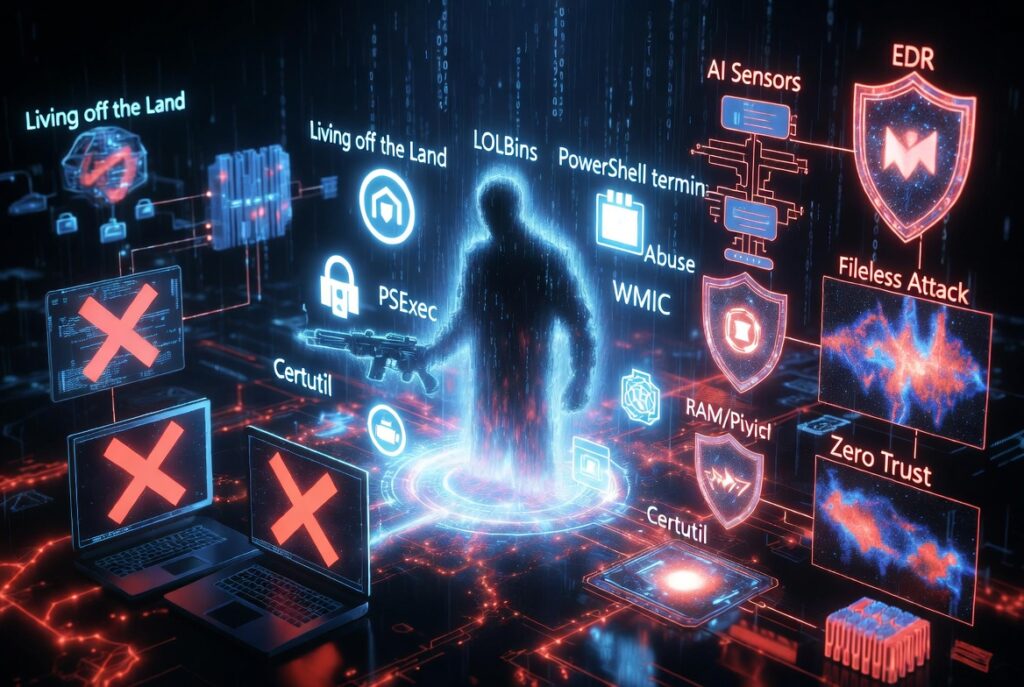
These Cyber Attacks represent a paradigm shift in hacking. Instead of importing external malicious files, attackers use the legitimate tools already baked into your operating system—PowerShell, PSExec, WMIC, and other trusted software—to conduct their nefarious activities. Because these actions are signed and trusted, traditional antivirus solutions often walk right past them.
To combat this invisible enemy, organizations must evolve from legacy antivirus to Advanced Security Strategies rooted in behavioral science, Zero Trust architecture, and next-generation threat detection. This article explores the mechanics of LotL Cyber Attacks and provides a comprehensive guide to building a defense that actually works.
In this article
- Understanding the Invisible Intruder: What Are Living-off-the-Land Cyber Attacks?
- The Anatomy of a “Ghost” Breach: How LotL Evades Traditional Defenses
- Advanced Security Strategy 1: Behavioral Analytics & Anomaly Detection
- Advanced Security Strategy 2: Fortifying the Network Infrastructure
- Advanced Security Strategy 3: Leveraging AI and User Profiling
- Advanced Security Strategy 4: Zero Trust and the Death of Implicit Trust
- Detecting the Unthinkable: Threat Hunting Techniques
- Building the SOC of the Future: Integration is Key
- Conclusion: Turning the “Land” into a Minefield
Understanding the Invisible Intruder: What Are Living-off-the-Land Cyber Attacks?
Before we discuss defense, we must understand the offense. Living-off-the-Land refers to a technique where threat actors use native system tools and processes—often called “LOLBins” (Living Off the Land Binaries)—to perform system administration functions that are also useful for hacking .
Also readHow Do UV Disinfection Devices Treat an Entire Room?Consider a scenario where an IT administrator uses PowerShell to remotely configure a server. That looks exactly the same as a hacker using PowerShell to scrape credentials from memory. To the naked eye, or to outdated security software, there is no difference.
These Cyber Attacks are particularly effective because they exploit the “trust gap.” Enterprises trust Microsoft applications. Firewalls allow traffic that looks like standard web traffic. According to behavioral security models, attackers no longer use general-purpose attack tools; they customize attacks using the tools that exist within the enterprise environment itself .
The Rise of “LOLBins”
LOLBins are not vulnerabilities; they are features. Some of the most commonly abused tools include:
-
PowerShell: Used for memory-only malware execution.
-
Mshta: Executes malicious scripts via trusted Microsoft HTML Applications.
-
Regsvr32: Regsvr32 can be used to script the execution of arbitrary DLLs.
-
Certutil: Often abused to decode stolen data or download payloads.
The Anatomy of a “Ghost” Breach: How LotL Evades Traditional Defenses
To understand why traditional security fails, we must look at the attack chain. In a LotL scenario, there is no “malware” file to write to disk. The attack is fileless or lives entirely in memory.
The Browser is the New Entry Point
Social engineering remains the king of initial access. Attackers trick a user into opening a malicious link or document. As noted by threat hunters, the moment a browser spawns a script or suspicious executable from a user-writable directory like “Downloads,” a silent alarm should go off. This is the “drive-by” execution moment .
Example Attack Sequence:
-
The Lure: An employee receives a phishing email.
-
The Click: The user downloads a seemingly harmless invoice (which is actually a script).
-
The Execution: The script runs not as a .exe, but as a command line invoking
PowerShell.exe. -
The Theft: PowerShell reaches out to a command-and-control server to download a payload directly into RAM, or it uses
Invoke-Mimikatzto dump passwords without ever touching the hard drive.
Case Study: The “Venezuela Energy” Wiper Attack
Recent Cyber Attacks on critical infrastructure highlight the destructive power of LotL. In late 2025, a wiper attack targeted Venezuelan energy firms. The operators did not just drop a virus; they used batch scripts and living-off-the-land techniques to map the network, undermine system defenses, and systematically delete critical data across the infrastructure. The malware specifically used two batch scripts to coordinate the attack throughout the target’s network, using legitimate administration tools to widen the blast radius .
“If the attacker is maliciously executing standard windows utilities to wipe systems, it’s already too late to think about detection. So, you’ve got to stop them earlier in the attack chain.”
Advanced Security Strategy 1: Behavioral Analytics & Anomaly Detection
Since LotL tactics mimic legitimate admin behavior, you cannot block the tools. You must block the behavior. This requires shifting from Signature-Based Detection (looking for a known bad file) to Behavioral Analysis (looking for a bad action).
How Behavioral Security Works
Modern Endpoint Detection and Response (EDR) and Next-Gen Antivirus (NGAV) solutions use sensors to monitor the “process tree.”
-
Learning Phase: The AI learns that “James in Accounting” never uses PowerShell.
-
Detection Phase: When a script attempts to invoke PowerShell on James’s machine, the system flags it as anomalous.
-
Action Phase: The system kills the process tree and rolls back any changes.
Tip: Look for solutions that use Attack Group Remediation (AGR) . Instead of killing a single process, AGR tracks process lineage and file lineage. If it detects a malicious PowerShell script, it finds every thread and process injected by that lineage and convicts the entire group .
Network Detection and Response (NDR)
You cannot put agents on every device (like legacy OT equipment or IoT sensors). This is where NDR shines. NDR tools analyze traffic patterns on the wire.
-
Monitoring IT/OT Convergence: For industries like energy or manufacturing, NDR monitors traffic jumping from the corporate IT network into the Operational Technology (OT) network, looking for suspicious lateral movement that might indicate a LotL attack .
-
Protocol Analysis: If a SCADA system suddenly receives a “shutdown” command from a random engineering workstation that never talks to it, NDR catches the anomaly.
Advanced Security Strategy 2: Fortifying the Network Infrastructure
Attackers aren’t just targeting laptops; they are targeting the network devices themselves. Cyber Attacks on network infrastructure (routers, switches, firewalls) are particularly insidious because these devices are often unmonitored or poorly logged.
In high-profile intrusion sets like “Salt Typhoon,” attackers used valid stolen credentials to access core networking equipment. Once inside, they used the native tools of the router to collect intelligence, jumping from the endpoint to the backbone of the company .
Securing the Network “Land”
To protect against infrastructure-based LotL, your security strategy must include:
-
Configuration Profiling: Fingerprint your network devices. If a router suddenly opens port 22 (SSH) when it never had before, or if encrypted traffic patterns change volume drastically, an alarm should trigger .
-
Encrypt All Management Traffic: Do not rely on Telnet or unencrypted SNMP. Use SSH, HTTPS, and SNMPv3 exclusively so attackers cannot sniff admin credentials off the wire.
-
Segmentation: Critical utilities must implement “Immutable Segmentation.” If an attacker compromises the HR database, they should not be able to ping the power grid controller.
Advanced Security Strategy 3: Leveraging AI and User Profiling
One of the biggest challenges in fighting LotL Cyber Attacks is alert fatigue. A security team might see thousands of PowerShell executions a day. How do you find the one that is malicious?
The solution lies in Dynamic User Profiling powered by Machine Learning. According to recent cybersecurity research, 84% of serious cyber incidents now involve LotL mechanisms. However, the vast majority of PowerShell usage is still legitimately used by IT staff .
Automating the “Good” vs. “Bad”
Security teams are segmenting users into behavioral groups to solve this:
-
The Task User (General Staff): These users (HR, Sales, Management) never need to run PowerShell or
nslookup. For them, a strict “Deny by Default” policy on script engines should be enforced. If a script runs on their machine, 99% of the time it is a Cyber Attack. -
The Knowledge User (IT/DevOps): These users need flexibility. Security policies should only allow specific scripts from specific signed directories.
-
C-Level Executives: These high-value targets require precise monitoring of privileged actions.
By aligning security rules with the role of the user, organizations can automatically block malicious script executions without hindering the workflows of their technical teams .
Advanced Security Strategy 4: Zero Trust and the Death of Implicit Trust
Living-off-the-Land Cyber Attacks thrive on trust. They trust that the network inside is “safe.” Zero Trust architecture is the direct antidote to this.
“Assume Breach”
Zero Trust dictates that you must assume an attacker is already inside your network. Therefore, every request for access must be fully authenticated, authorized, and encrypted.
-
Micro-segmentation: Break the network into tiny zones. LotL attacks rely on lateral movement (e.g., using PSExec to hop from PC to PC). Micro-segmentation blocks that lateral movement at the firewall level, even if the attacker has valid admin credentials.
-
Just-in-Time (JIT) Access: Do not give permanent admin rights. Attackers love to steal longstanding admin accounts. JIT access elevates privileges for 15 minutes for a specific task and then revokes them. This leaves no “land” for the attacker to live off.
Detecting the Unthinkable: Threat Hunting Techniques
Even with the best prevention, detection is key. Your security operations center (SOC) must actively hunt for the “needle in the stack.”
1. Command-Line Auditing
Most organizations disable command-line auditing because it takes up space. Enable it. You cannot hunt LotL without it.
-
What to look for:
powershell -enc(encoded commands),regsvr32 /s /u /i:(a common scriptlet execution pattern), or attempts to reach out to non-standard ports viacertutil.
2. The Browser-to-Binary Chain
As highlighted by threat hunters at RSM, a major red flag is a parent-child process relationship where a Browser (like Chrome) spawns a Command Prompt (CMD) or PowerShell. This is virtually never a legitimate operation .
Hunting Query Logic: Alert if
Parent Processischrome.exeORfirefox.exeANDChild Processispowershell.exeORcmd.exe.*
3. Looking for “Living off the AI Land”
The newest frontier of Cyber Attacks involves abusing AI tools. Attackers are now “Living off the AI Land,” using legitimate AI services to write attack scripts or, in advanced cases, using AI agents to manage command-and-control infrastructure. Security teams must monitor internal API calls to LLMs for anomalous volume or data exfiltration patterns .
Building the SOC of the Future: Integration is Key
No single tool stops a determined LotL adversary. You need integration.
-
SIEM + NDR + EDR: Your Security Information and Event Management (SIEM) must ingest logs from your EDR (endpoints) and your NDR (network).
-
The MITRE ATT&CK Framework: Align your defenses with the MITRE ATT&CK framework. Focus specifically on “Defense Evasion” (T1218) and “Execution” (T1059) tactics. Mapping detections to MITRE ensures you are covering the gaps .
Actionable Takeaway: Run an exercise today. Check how many of your endpoints run “PowerShell.exe” in a silent mode. If you aren’t logging the scripts, you are blind.
Conclusion: Turning the “Land” into a Minefield
Living-off-the-Land Cyber Attacks represent a maturation of hacker tradecraft. They have realized that they don’t need to bring guns to a knife fight; they can use the knives the victim already owns.
Protecting against these threats requires a psychological shift. You cannot simply trust your own tools anymore. You must:
-
Watch the Behavior: Implement behavioral analytics to catch the impersonation of IT staff.
-
Hunt the Anomalies: Look for the weird parent-child relationships like Browser->CMD.
-
Segment the Network: Stop lateral movement at the router level, not just the endpoint level.
-
Profile the User: Use AI to define “normal” and alert immediately on “new.”
By adopting advanced security strategies—leveraging AI, Zero Trust, and proactive threat hunting—you can turn the “Land” that attackers rely on into a hostile environment. You cannot stop them from using PowerShell, but you can ensure that every time they try, you are watching.

Get in Touch We welcome your feedback, inquiries, suggestions, and news tips. Whether you are a reader, advertiser, or business partner, our team is here to assist you. Email: businesstomark@gmail.com