How to Choose the Right Stainless Steel 304 Plate for Your Project
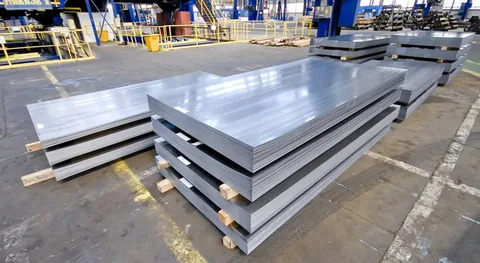
Grade 304 covers most general stainless requirements, but the plate that suits a food processing tank will not always suit a coastal handrail or a heat exchanger baffle. Selection depends on service environment, operating temperature, mechanical load, thickness, finish, and the specification the plate carries. Corrosion-resistant SS 304 Plates hold their surface in humid, mild-acid, and clean- water service. The rest comes down to matching an austenitic grade with good forming and welding behavior for the job.
In this article
What Is a Stainless Steel 304 Plate?
304 sits in the austenitic family, with roughly 18% chromium and 8% nickel holding the structure stable at room temperature. Chromium forms the passive oxide film that resists corrosion. Nickel keeps the plate non-magnetic in the annealed condition and helps it form and weld without cracking. Fabricators cut, roll, press, and join it without preheating. ‘SS 304 Plate,’ ‘304 Stainless Steel Plate,’ and ‘Stainless Steel 304 Plate’ all refer to the same material. The naming changes with the buyer, not the specification.
Why Is SS 304 Plate Commonly Used?
Availability drives a lot of it. Mills supply the grade from 1.5 mm to 100 mm, in finishes from no. 1 hot-rolled to mirror polish, so procurement rarely waits. It welds with 308L filler. It forms without tearing. The smooth passive surface is cleaned after every shift, which is why dairy and pharmaceutical plants specify it. In seawater spray, hot chloride solutions, or sustained high heat, 304 stainless steel can fail, and a higher alloy is worth the cost.
 Also readHow Early U.S. Couples Start Shopping for Engagement Rings Before the Proposal
Key Properties of 304 Stainless Steel Plate
Check these against the mill test certificate before release, not against a generic supplier datasheet.
Corrosion Resistance
The chromium oxide film handles nitric acid, organic acids, and potable water. Chlorides break it down locally, and pitting follows.
Tensile Strength
ASTM A240 sets 515 MPa as the minimum for TP304. Cold work during forming pushes measured values higher.
Yield Strength
The 0.2% proof stress starts at 205 MPa. Design against the certified value on your ASTM A240 TP304 plate, not a catalogue average.
Ductility
Minimum elongation sits at 40% in 50 mm. That headroom absorbs deep drawing and tight radii.
Formability
The grade cold works readily and hardens as it goes. Heavy forming needs an intermediate anneal to restore ductility.
Weldability
All standard processes apply. Keep heat input low and interpass temperature controlled on thicker sections.
Temperature Performance
Scaling resistance holds at about 870 degrees Celsius, but only intermittently. Sustained heat drops allowable stress and attacks grain boundaries.
Surface Finish Options
Nos 1, 2B, 4, and mirror finishes suit different work. Finish affects cleanability and pitting, not appearance alone.
Factors to Consider When Choosing Stainless Steel 304 Plate
Six questions settle most plate enquiries. Work through them before the purchase order.
Application Requirements
Structural framing, pressure equipment, food contact surfaces and cladding each pull the specification in a different way. Fix the end use first. Thickness and finish follow.
Corrosion Environment
List what touches the plate. Chlorides from seawater, bleach or salt spray cause pitting and stress corrosion cracking above roughly 60 degrees Celsius.
Plate Thickness
Load, span and deflection limits set the minimum. Fabrication pulls the other way, since anything above 12 mm needs heavier rolling and more edge preparation.
Operating Temperature
Strength falls as temperature climbs, so hot service needs allowable stress values from the design code. Between 425 and 815 degrees Celsius, carbide precipitation reduces corrosion resistance.
Fabrication Requirements
Laser and plasma cutting suit thinner plates. Heavier sections go to waterjet or sawing, and bending needs a larger radius because springback is higher.
Surface Finish
Hygienic equipment needs to be 2B or better so that residue cannot lodge in the surface. Architectural work moves to No. 4 or a mirror, where appearance carries weight.
Stainless Steel 304 Plate Applications
The grade turns up across processing plants, construction sites and equipment manufacturing. A few examples show where it fits.
Food, Dairy and Pharmaceutical Equipment
Passive surfaces resist organic acids in juice, milk and fermentation service. Vessels, hoppers and cleanroom panels use the grade.
Chemical Processing and Storage Tanks
Tanks holding nitric acid, alkalis, and process water sit within the grade’s limits. Chloride-bearing streams need 316L or duplex.
Kitchen and Commercial Equipment
Worktops, splashbacks, cooking ranges and sinks take 304 for hygiene and dent resistance. Cleaning agents leave no staining.
Architecture and Construction
Cladding, balustrades, canopies and fixings retain their finish in urban air for decades. Coastal sites need a molybdenum-bearing grade.
Industrial Machinery, Automotive and General Fabrication
Machine frames, guards, brackets, trim panels and exhaust components use the grade for forming and weld performance.
When Should You Choose Stainless Steel 304 Plate?
304 makes sense where service conditions remain mild to moderate and the fabrication work is heavy. Weld it, form it, polish it, and the plate holds up. Material cost sits below 316L, 317L and every nickel alloy, which matters on large tank shells. Where the plate meets warm chlorides, reducing acids or continuous heat, move up to 316L or 904L.
Conclusion
Environment, mechanical load, thickness, finish,, and fabrication method decide whether 304 is the correct call. Confirm the plate against the required ASTM A240 TP304 plate limits and read the mill test certificate before acceptance. For industrial, architectural, and processing work, the grade covers more ground than any other stainless steel.

Covers business ideas, small business finance and technology for Business Recorder.